The Economics of an Intentional Customer Journey
How customer understanding, differentiation, experience and revenue operations create compounding business growth.
The customer does not experience your departments
Businesses invest heavily in marketing, sales, technology, branding, service and operations — then optimize each one independently. The customer experiences none of that. They experience one company, across one relationship, from the first search result to renewal and referral. When that journey is accidental, the organization creates friction it cannot see. When it is intentional, the result is not better marketing. It is a better-performing business.
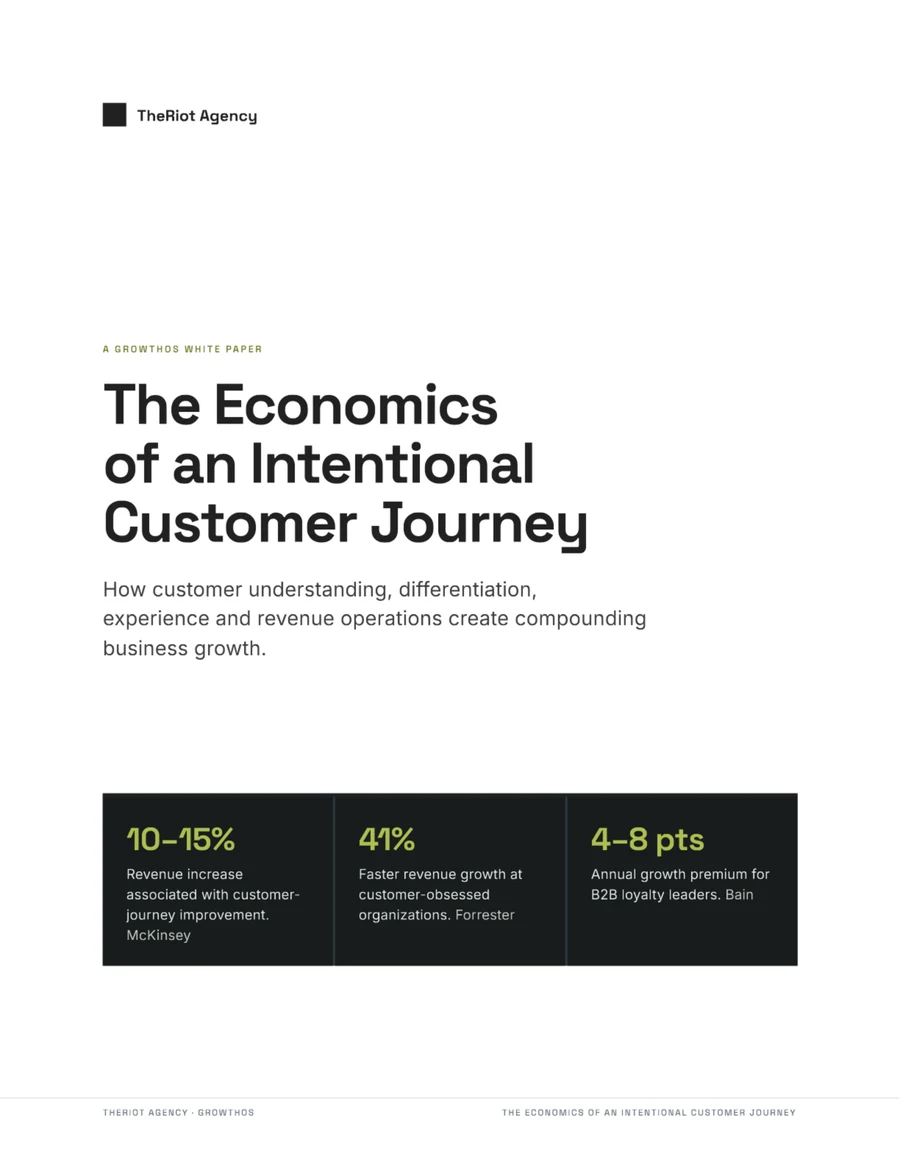
Growth is not produced by a collection of isolated marketing, sales and customer-service activities. Growth is produced by a system that continuously converts customer understanding into customer value, and customer value into enterprise value.
The same eleven stages, two different systems
In an accidental journey, six owners each do their job and context is dropped at every handoff: onboarding re-asks the basics, delivery inherits promises it did not make, renewal discovers a surprise. In an intentional one, context is the thing that moves. McKinsey studied roughly 27,000 consumers across 14 industries and found satisfaction with the whole journey was 30% more predictive of overall satisfaction than satisfaction with any individual interaction — which is why a company can optimize every department and still deliver an inferior experience.
What is inside
Twenty-seven pages, six figures, every source cited and linked.
The hidden cost of an accidental journey
Why a company can optimize every department and still deliver an inferior experience — and what journeys predict that touchpoints do not.
The right customer, not more demand
The nine questions a useful ICP answers, and what broad segmentation costs in wasted sales time.
Differentiation and positioning
Difference has no economic value unless the customer values the difference. Value Created × Value Understood = Value Captured.
Eleven stages, eleven questions
The journey as the business: what the organization thinks is happening, against what the customer is actually experiencing.
Experience as an economic engine
What McKinsey, Bain and Forrester each measured, what it did to revenue and cost, and where the numbers disagree.
The Intentional Growth System
Four phases, fifteen stages, one loop — plus a maturity model across eight dimensions and five levels.
The evidence comes from
Read the paper
Tell us where to send it and the paper lands in your inbox. Two fields, no follow-up you did not ask for.
Now score your own journey
The paper makes the case. The assessment shows where yours leaks: six stages, three questions each, a score for every stage and the one to fix first. Ten minutes.